Saturday, July 20, 2013
 Multiplication and Division of Integers, especially when mixing positive and negative numbers can be tricky! Luckily mathematics provides us with some rules that always prove true and can help to guide us through this, sometimes confusing process.
 Rule for the relationship between Multiplication Division:
Integers: Addition & Subtraction

Addition & Subtraction of Integers
What is a Number?
A mathematical symbol of value. Numbers are used to measure, count, and label.
Integers are positive whole numbers, negative numbers, and zero.
Is Zero a Number?
It has NO VALUE... yes it does, it has a value of NONE!MindMap
The above link will bring you to a "Mind Map" that I created on the topic of inters. This map is full of links to websites containing videos, lesson plans, games for students, problem examples, and helpful tips on how to explain some of the concepts included in the idea of numbers.


The Addition of Integers
Video Explanation of Integer Addition
THE RULES
- (+/-) When adding two integers with unlike signs (one positive and one negative) look at their absolute values and subtract the smaller one from the larger, the answer will have the same sign as the larger.
- (-/-) Add the absoute values and attach a negative sign (-) to the sum.
- (+/+) Just add together, the answer will be positive.
- In adding integers, it does not matter which you add first, second, third, etc. you will get the same sum in the end no matter what order you add them in.
Addition is the combining of two or more values into one. In early mathematics students may benefit from using manipulatives such as counting blocks or other objects, dice, dominoes, or their fingers. Color coded counters or charged-field modeling becomes more useful once students are dealing with negative numbers. A good resource for buying these math manipulatives for use at school or home can be found at www.learningresources.com
The Subtraction of Integers
Every positive number has an opposite, or negative number, for 3 it is -3, for 297 it is -297 and for -8 it is 8. When we subtract we essentially add the opposite: a-b=a+(-b). Subtraction means to take a value away from an original value, to remove some. A good video that provides a step-by-step example of the process of subtracting can be found at MathHelp.com
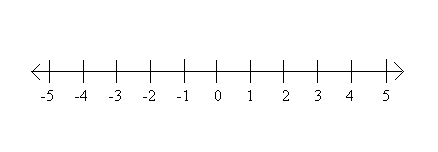
Using Number Lines to Add & Subtract
Number lines can provide a great visual representation of where a number lays in regard to value compared to other numbers. It is helpful to be able to count forward (right) or backward (left) as needed. Numbers increase in size, or value, as you move right on the number line. ALL numbers have their own special, unchanging, place on the line. In the center of this infinite line of numbers is zero. Zero is at the center because it has a value of none and is neither positive or negative. All numbers to the right of zero are positive, and to the left are negative.
Educational & Fun Games for Addition, Subtraction and Numberline Practice can be found at:
Wednesday, June 26, 2013
Teaching Elementary Estimation Skills
 Estimation
"We always need more people who can think," were the closing words of an article I just read by
Robert J. Doman Jr. Who can argue with that?!? Estimation in math does just that, helps people think. When you estimate you go beyond rote memorization, you are not just applying a meaningless formula. What you are doing is asking, "what is the value of these symbols," and, "does this make sense?" It helps you to understand the concept and it's applicable meaning.
Two other benefits of estimation, Dorman points out, are visualization and conceptualization.
 When a student is completing a math problem often it is helpful for them to visualize or conceptualize it in some sort of real-world situation, forming a mental picture. Associating meaning to math is very helpful to children, particularly in the primary grades. For example, if I ask a 2th grader what 5-7=? I may be met with a blank stare. If I phrase the question as a familiar situation,"If you are at the toy store with your mom and you see a toy that costs $7.00, but you only have $5.00 with you, how much do you owe your mom when you get home?" The child will quickly respond, "Oh, that's simple, I had to borrow $2.00 from her," they understand better when it is a situation that they can relate to, one that they can envision.
Teaching Estimation
Estimation by rounding
 When a student is asked to estimate in a simple computation problem, often what the question is asking them to do its round. Rounding is also a handy skill when checking over problems. If a student ends up with 97 when subtracting 406 from 603 he or she can quickly assume that is not a reasonable answer. This quick check prompts them to take a closer look, noticing that they simply forgot to bring complete the last step and place a one in the hundreds place.
Estimating Length or Distance
Now, here's a concept best taught hands-on. Get out the rulers & meter sticks! Comparisons of things of different lengths, which is larger or smaller, taller or shorter will give them a real-world idea of what these measurements actually mean.
Maps are another helpful tool when teaching distance estimation. Plotting multiple points on a map and asking a question such as, "The Jones family is planning a trip. They have a budget of $290 to spend on gas for their vehicle that gets approximately 30 per gallon. If the price of gas is $2.89 per gallon which destinations on their wish list are options for their trip? (Don't forget, they have to get back home!)"
Estimating Numerical Value
What is 76? Well, it's more than 50, which would be half way between 0 and 100, that's a good start. Conceptualizing where a number lies in relation to other numbers. This concept is helpful in teaching anything from beginning addition to decimals and fractions!
Useful Links in Estimation:
 |
| http://www.math.com/ |
 |
| http://nacd.org/newsletter/0309_estimation.php |
Some estimation and rounding online practice can be found at:
 |
| http://www.aaamath.com/est.htm |
Visit:
http://www.transum.org/ For a list of Maths lesson starter activities and interactive exercises for students on the topic of Estimating. Free for students and teachers!
And, finally, the most useful article I found:
Developing Estimation Skills in the Primary Grades
Fantastic teaching strategies and activities!
Subscribe to:
Posts (Atom)